Checked twice, and the second check is ours
Cases do not ship from the production facility to your practice. They come to Aligner Magic in the United States first, and are verified against the plan you approved before they go anywhere near a patient.

Printed, formed, cleaned, finished.
Every one of these is a place a case can go wrong, which is exactly why every one of them is a place someone signs off.
01Model printing
Production starts from the staged files the prescribing dentist approved. There is no separate copy, and no later edit.
- Models printed from the approved plan version and nothing else
- Batches stay tied to the case they belong to
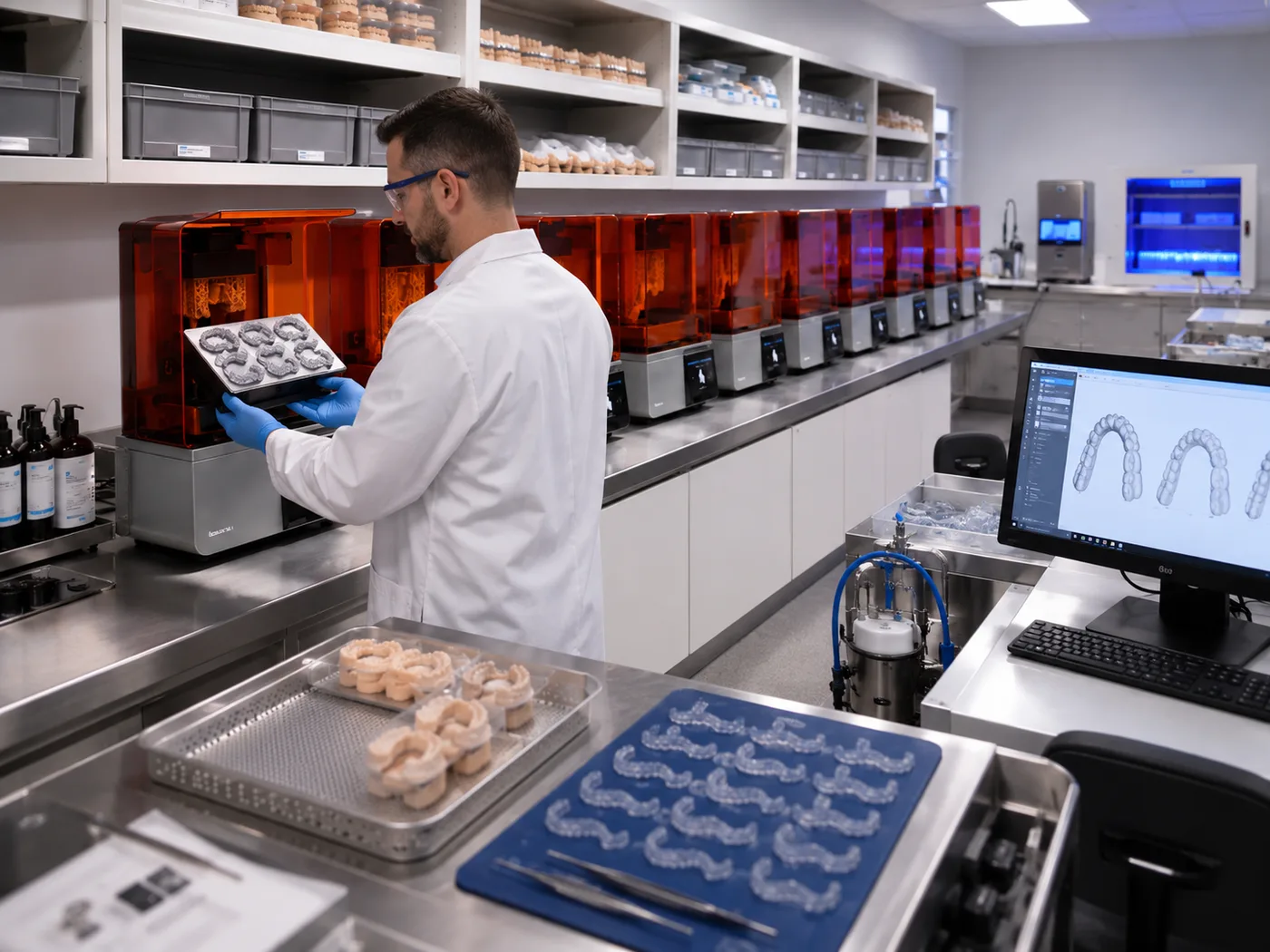
02Washing and curing
Nothing moves to the next bench until this is finished, because a residue problem found later means remaking the tray rather than cleaning it.
- Printed parts washed and cured before anything is formed over them
- Formed trays cleaned again before finishing

03Cleaning before finishing
Unglamorous, and where most of the finish quality is actually decided.
- Handled in batches that stay tied to their case throughout
- Trays checked for deformation before they reach the trimming bench


At the factory, on arrival in the United States, and again before dispatch.
A blocking failure or a count mismatch is a hold. The hold is derived from the result, never chosen, and there is no override.
01Manufacturer quality control
- Produced count matches the expected count
- Upper and lower counts correct
- Stage sequence complete with no gaps
- Trimming and polishing acceptable
- No visible defects, cracks or deformation
- Case and step labels correct and legible
- Packed into Aligner Magic supplied packaging

02U.S. receiving
- Carton condition recorded before anything is opened
- Every case scanned against the expected manifest
- Missing, unexpected and damaged items flagged immediately
- Discrepancies recorded on the receipt, not resolved informally
03Final Aligner Magic quality control
- Case ID matches the expected case
- Aligner count matches the approved plan
- Upper and lower sequences complete and in order
- No duplicate or missing stages
- Labels present and readable
- Packaging undamaged and contents match the production manifest

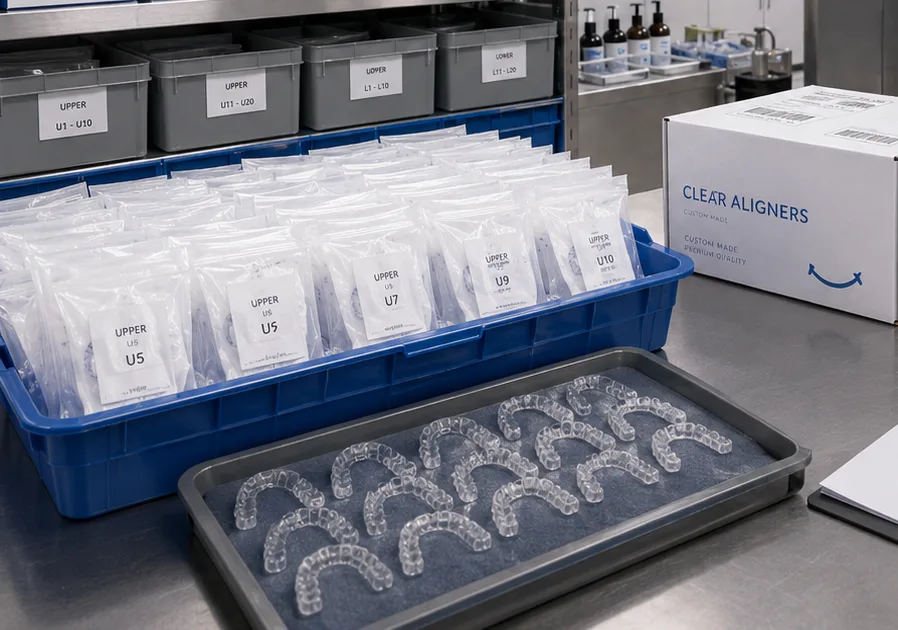
Packed the way it will be handed over
The last check is the one the patient sees. Cases arrive in Aligner Magic packaging, in stage order, ready to hand across the desk without repackaging.

Branded box
The outer carton the case ships in.
Sealed per stage
Each tray bagged and labelled with its arch and stage code.

Aligner case
A hard case for the tray the patient is wearing.

Case card
Printed instructions and the case number, opened at the chair.
Packaging carries the case number, the arch and the stage code. Patient identity does not travel with the product.

A hold is not a delay you have to chase.
A failed check stops the case and names the specific problem. You are told what happened rather than left waiting for a case that is not coming.
What a hold does
A failed check produces a hold, and a held case does not ship. That is the entire point of doing the check.
- The hold names the specific problem — a missing aligner, a wrong step, a duplicate, a label error, a quantity mismatch
- The case stays on hold until a person resolves it and records how
- If it needs remaking, a tracked remake is opened with the responsibility recorded
- You are told what happened rather than left waiting for a case that is not coming
Traceability
Every quality check is recorded against the checklist version that was in force at the time, so a record from last year still reads correctly after the checklist changes.
- Each production file carries a SHA-256, and the approved plan carries a fingerprint over all of them
- The production package must reproduce that fingerprint — approved content is the only content that can be manufactured
- Material, thickness and lot are captured at manufacturer QC where the vendor supplies them
- Who checked what, and when, is recorded and cannot be edited afterwards
Aligner Magic does not display regulatory registrations, clearances or certifications that have not been supplied and verified. Where a supplier has not provided documentation, our records say exactly that rather than leaving a comfortable gap.
Questions about the process?
We would rather answer them before you send a case than after.